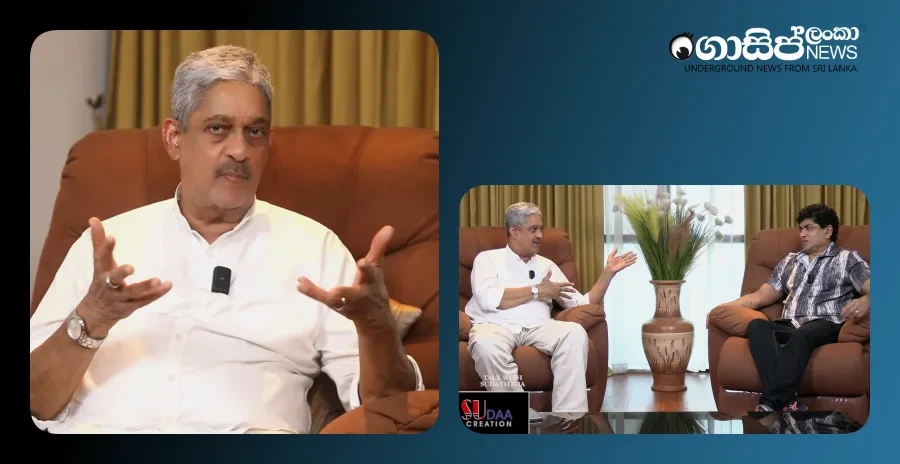
Field Marshal Sarath Fonseka is a unique political and military figure who is highly loved by the majority of the people in this country, yet severely criticized by a political few. According to information recently revealed in Parliament, certain controversial activities allegedly carried out by former intelligence chief Suresh Salley have been exposed with evidence as having been done purely for political motives.
Although Suresh Salley coordinated all these operations, Mr. Sarath Fonseka, appearing on Sudha's channel, points out that the true mastermind and planner was the then Secretary of Defence, Gotabaya Rajapaksa. He further emphasizes that Suresh Salley did not take any decisive steps without Gotabaya Rajapaksa's approval and direct knowledge.During Mr. Sarath Fonseka's tenure as Army Commander, an officer named Suresh Salley did not hold any responsible position; he was merely engaged in preparing reports from an office. Due to his ability to handle the Tamil language and his skill in writing reports in English, he lived a luxurious life in Colombo, pleasing senior officers under Hendavitharana, who was then the head of intelligence. Although Mr. Sarath Fonseka removed these individuals from active military positions, Gotabaya Rajapaksa later assigned them to his private headquarters at the Ministry of Defence. During that era, military intelligence was at a very weak level, and they presented incorrect data to the Defence Council regarding the strength of the LTTE organization. Although intelligence agencies falsely reported only nine thousand LTTE members at the time, Mr. Sarath Fonseka's battlefield analyses confirmed that the number exceeded thirty thousand. It is revealed that officers like Hendavitharana and Salley made no real contribution to the Fourth Eelam War and operated solely as a group for Gotabaya Rajapaksa's political interests.
It must be recalled here that although some religious leaders and individuals like Galagodaaththe Gnanasara Thero raised their voices about the injustices faced by war heroes in the past, they showed no sympathy for war heroes when Mr. Sarath Fonseka was cruelly imprisoned. Among those who celebrated with the Rajapaksas at that time were these very intelligence officers. Although some Gajaba Regiment loyalists within the army attempted to defame Mr. Fonseka on social media due to political influence, the general public was well aware of his true service to the country.
Mr. Sarath Fonseka's two and a half years at Welikada Prison were extremely difficult and filled with vengeance from the Rajapaksas. He was secretly taken to the prison around midnight so that the public and other prisoners could not see him. The small room where he was held was surrounded by barbed wire, completely isolating him from the outside world, and even fans or television sets were initially removed. Although he could not sleep on the floor due to shrapnel in his body from bomb attacks during the war and lung ailments, prison authorities provided him with only a small wooden bench about two feet wide. He fell off the bench twice while sleeping without a mattress. His wife was allowed to visit him only once a month for thirty minutes, and these discussions were strictly monitored in the presence of prison guards. Despite all these inhumane tortures, he maintained his mental strength, spending his time using a fan, a television, and a treadmill for lung exercises, which were later provided by court order, and he remained determined to legally stand against this injustice.
Mr. Sarath Fonseka states that according to the massive public support during the 2010 presidential election, he should have definitely won, but the result was altered due to political conspiracies and vote rigging. He alleges that powerful figures in the then opposition did not show proper interest in protecting the vote counting centers during the final weeks of the election, and that results were changed by launching mob attacks, expelling opposition representatives, and forging signatures. Ballot boxes were found in drains in many places like Gampaha, and the Rajapaksas stole the public mandate by misusing state power, money, and property. He also recalls that people voluntarily flocked to Mr. Fonseka's rallies in areas like Maharagama, blocking roads, while the Rajapaksas' rallies were deserted.
Mr. Sarath Fonseka states that he expects justice to be served fairly under the current government, and legal action should be taken against the Rajapaksas and their associates for treasonous acts such as large-scale corruption, misuse of state property, and funding terrorists. The opposition's accusation against the current government, "hunting war heroes for diaspora interests," is completely false. The real betrayals were committed by the Rajapaksas in 2008, who attempted to disrupt the Weli Oya front and secure a ceasefire. After the arrest of 'KP,' who led the LTTE's international network, nothing happened to the organization's money and ships, and members of the Rajapaksa family are accused of using those funds to start businesses in countries like Malaysia. Mr. Sarath Fonseka emphasizes that since the people have moved away from party politics and rejected the country's old corrupt political culture, the time has come for Mahinda Rajapaksa, Gotabaya Rajapaksa, and all members of their family who destroyed the country to face punishment according to the law of karma (dittadhammavedaniya kamma).