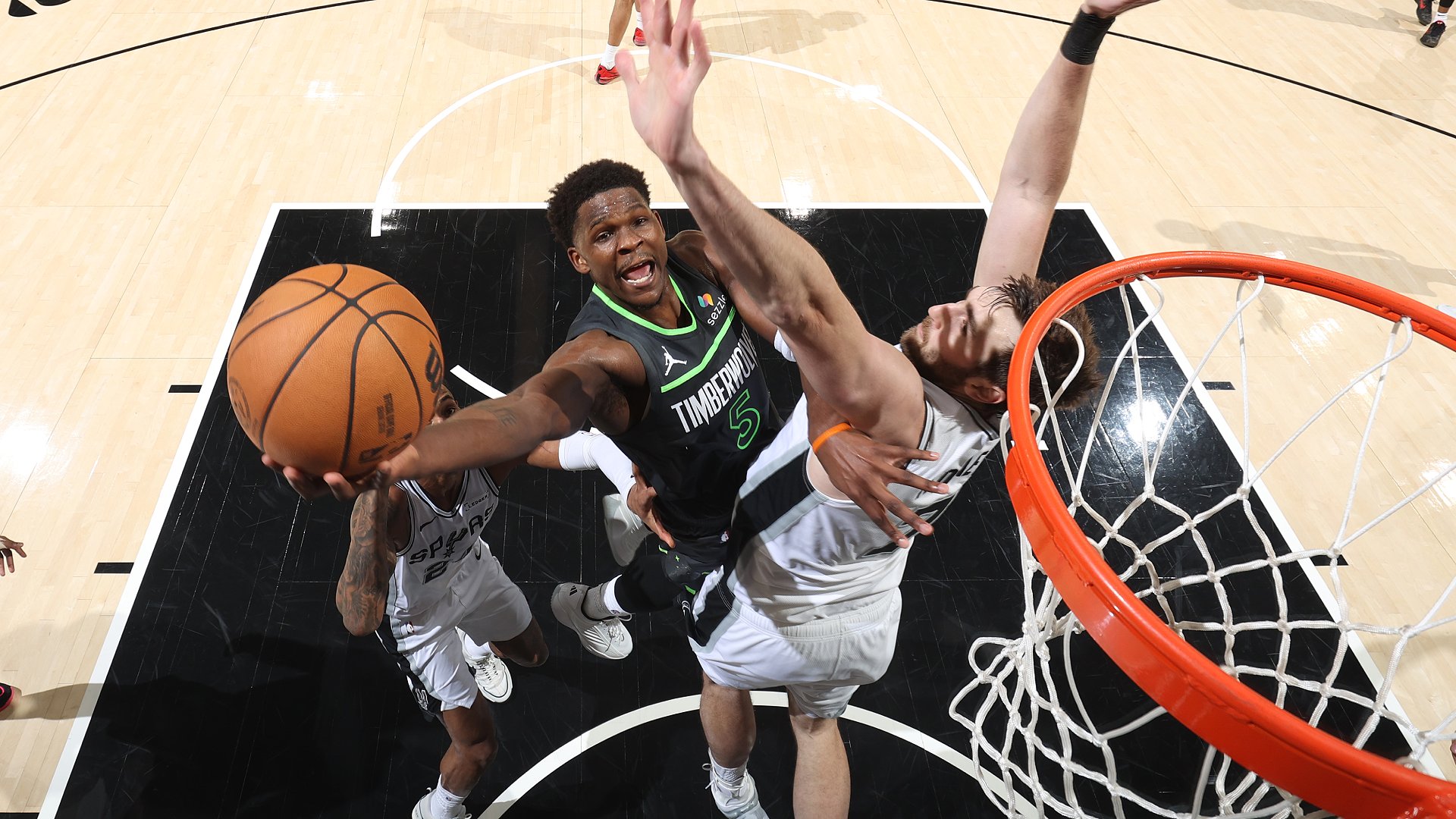
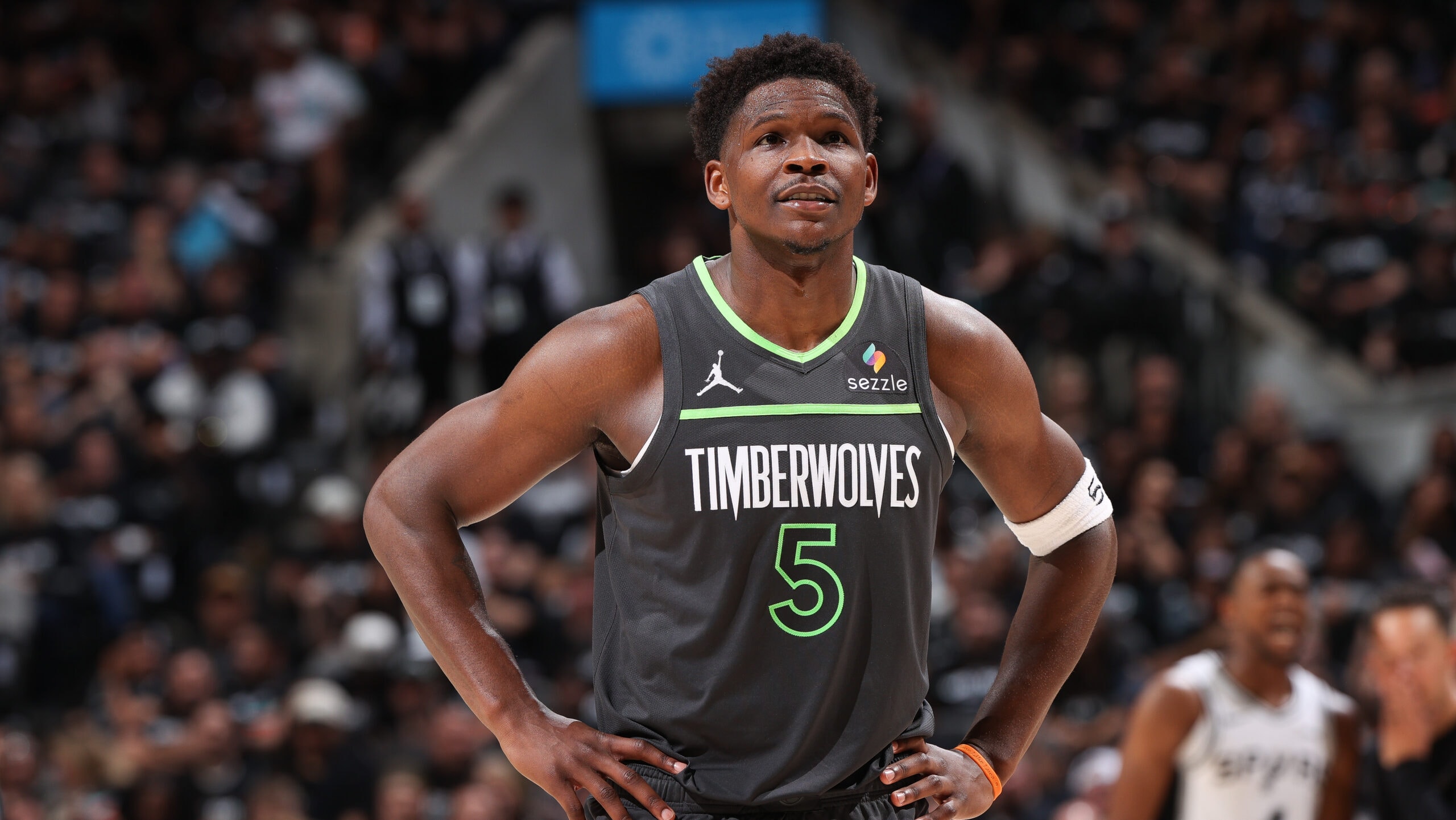
Anthony Edwards, still recovering from a bruised and hyperextended left knee, has combined for just 30 points in Games 1 and 2.
Thirty-eight points normally is enough to win an entire playoff series and clearly overkill for any single game. Consider, a year ago, the Minnesota Timberwolves beat Golden State in the Western Conference semifinals by a total of 36 points over five games.
Back in the NBA’s second round again this spring, the Wolves got blown off the court at San Antonio’s Frost Bank Center in Game 2 Wednesday by 38, 133-95.
That makes the teams’ respective goals heading into Game 3 on Friday (9:30 ET, Prime Video), ostensibly simple. The Spurs want to replicate their performance as much as possible when both participants in a dynamic series are doing their best to be moving targets. Minnesota, by contrast, wants to make their guests at Target Center wish they’d held some of that bloated margin in reserve as emergency points they’ll need going forward.
Here are three things to watch for at 1-1, with the Spurs eager to grab back home-court advantage even as the Wolves try to assert some:
1. Edwards to flash his All-Star form
Ask any Wolves fan what their team needs to find an extra gear in Game 3 and they’ll say “More Ant” – and they won’t be talking about Memphis’ point guard. Anthony Edwards understandably has had a muted impact so far, owing to his ahead-of-schedule return from a bruised and hyperextended left knee (while not fully recovered from a sore right knee).
That reality doesn’t cut him any slack with the Spurs, who have limited Edwards while on the court to a combined 30 points in Games 1 and 2. Coming off the bench both nights, Edwards chastised himself after giving up a pair of crucial rebounds late in the opener, then had turnovers while posting a personal playoff worst minus-23 in his 24 minutes Wednesday.
Edwards still drew the defensive respect from San Antonio of being double-teamed, but he dealt with the traps less effectively than usual. His 13 shot attempts in each game tied for third-fewest in his 48 playoff performances, and he has scored 30 points or more – in single games, not two – 16 times.
Through their runs to the conference finals in 2024 and ’25, Edwards’ talent and the stress it puts on opponents has been Minnesota’s superpower. Its record when he has scored 20+ in a playoff game: 19-14. And when he hasn’t: 6-9.
He probably should be back in the starting lineup, his minutes need to ramp up and forget about letting the game “come to him,” as some coaches will advise. For the Wolves’ good, Edwards need to seize it by the neck.
2. Less tipoff, more starting block
Expect both teams to aim for quick, explosive starts. San Antonio did that in Game 2, rocking the Wolves in the first quarter with aggressive offense from point guard De’Aaron Fox and Victor Wembanyama. Minnesota knows that an early pounce is the surest way to maximize the series’ shift to Minneapolis and, frankly, the extended happy hour of an 8:30 local time tipoff.
“Whenever we’re able to start games off pretty well, we’re usually on the front foot,” Fox said, after he and Wembanyama flexed repeated pick-and-rolls that got both Spurs going. “When we’re the aggressors, we’re able to win most of those games.”
Wolves forward Julius Randle saw the flip side of the Spurs’ fast start. “They out-hustled us, out-physicaled us, out-executed, played better defensively, more energy.”
Bringing immediate intensity guarantees nothing over 48 minutes, but not bringing it almost assures the less frenetic team of an uphill night.
3. A little Denver dislike from McDaniels
Jaden McDaniels is Minnesota’s best and most versatile perimeter, with plenty of San Antonio weapons in need of holstering if his team hopes to prevail. The lanky, normally laconic wing added to his impact in the first round by aggravating Denver with some “bad defenders” jibe after Game 2 and his late layup at the end of Game 4.
If McDaniels isn’t going to pop off or irritate the Spurs in similar fashion, he at least needs to clamp down on one or more of San Antonio’s scoring threats. The biggest obstacle so far? Foul trouble. He got whistled for five in the opener and had a quick three in Game 2, sending him to the bench. In his absence, the Spurs’ lead ballooned from eight points to 24.
“Jaden was a bright spot for us,” Wolves coach Chris Finch said. “(The fouls) certainly derailed his night, and we were never able to really benefit from a very good Jaden, which is important to us.”
That explained how McDaniels emerged from the 38-point drubbing with a mere minus-6 in his 19:35 minutes. But he has been and should be averaging double that, a disruptor picking up in the backcourt and certainly before San Antonio gets downhill into Rudy Gobert.
Against this foe, however, McDaniels might want to let his game do his talking. Wembanyama was asked before Game 1 about that sort of extracurricular, and he sounded as if he almost welcomed it.
“Talking is not something that bothers me,” the elongated one said. “Yeah, it’s exciting. It makes the game even better. I always appreciate people helping me push through my limits.”
* * *
Steve Aschburner has written about the NBA since 1980. You can e-mail him here, find his archive here and follow him on X.
Page 2
Victor Wembanyama and the Spurs have been smothering Wolves star Anthony Edwards and his Minnesota teammates.
We’ve got another week to figure it out if the Spurs and Timberwolves can stretch out their Western Conference semifinal series to maximum length.
In the meantime, “Game 4” is tasty enough. If a best-of-seven series is at 3-0, the fourth game can put the trailing team out of its misery and allow the rest of us to move on.
But if it’s 2-1 the way this series is, with the Spurs in front, Game 4 Sunday (7:30 ET, NBC) is as pivotal as an uncharted crossroads with no turning back.
If San Antonio is as greedy as it wants to be at Minneapolis’ Target Center, it will have a commanding lead that assures advancement about 95% of the time. It would set up the Spurs nicely for what could be an epic showdown in the West with OKC.
But if the Wolves fire back to make this 2-2, the pressure mounts for the Spurs not to lose Game 5. Minnesota is assured of another home game and the prospects of the series going seven improve considerably.
After two straight trips to the West finals, Minnesota sees the next round as its rightful turf. The Spurs are closing the experience gap with the veteran Wolves with each passing game and aren’t inclined to defer now.
Here are three things to watch for Sunday:
1. Quicker relief valve for Edwards
Having Victor Wembanyama near the basket while his teammates are throwing defensive double-teams at Anthony Edwards early in possessions has led many times to sluggish, indecisive offense for the Wolves.
One reason? Donte DiVincenzo, Edward’s backcourt stalwart all season, is out for the foreseeable future after rupturing his right Achilles tendon in the Denver series.
DiVincenzo never was shy about immediately making a defense pay by firing from 3-point range. He led his team with 244 3-pointers in the regular season, launching eight per game.
It was the surest way to pull some of that help away from Edwards, the Wolves No. 1 threat. With DiVincenzo out, Edwards at times – especially in the first two games – was slower to move the ball. And when he did, the recipient didn’t swiftly make the Spurs pay.
Victor Wembanyama scores a playoff career-high 39 points, along with 15 rebounds and five blocks in a Game 3 win.
Wembanyama’s long presence and Wandering Albatross wingspan (look it up) makes the basket at San Antonio’s end seem closed even when it isn’t.
Wemby’s teams seem less vulnerable in their rotations. Minnesota needs to inflict immediate pain a few times to soften the focus on Edwards, but with the exception of veteran Mike Conley, none of the other starters is a quick-trigger shooter.
Something has to give, because the Wolves’ offense has been looking the way Edwards’ achy knees might feel. After scoring 115.6 points per 100 possessions in the regular season and 112.8 in the first round against the Nuggets, it is at 100.0 through these three games. That would have ranked last in the league by a wide margin during the season.
2. Time for role players to … roll
We all know the cliché by now: Role players play better at home in the playoffs. The Wolves need some of that before they head back on the road for Game 5 Tuesday.
Naz Reid’s 18 points on Friday don’t quite qualify because Reid is so essential to the rotation – he played longer minutes in Game 3 than three of the starters. Ayo Dosunmu was helpful with 11 points, seven boards and five assists. Terrence Shannon Jr. was an odd plus-19 while scoring only five points on 2-for-6 shooting in more than 28 minutes.
Playing only eight is a tough way to go, especially with games every other day. A spate of instant offense from shooter Bones Hyland or some disruption from guard Jaylen Clark could be the X-factor the Wolves need to even things up.
3. Savor young Wembanyama
Skeptics, longtime NBA followers and certainly fans of rival teams can be excused if they’ve been slow to climb aboard the Wembanyama band wagon through the young man’s first three NBA seasons. It took San Antonio until this season, after all, to reach the playoffs – 22 and 34 victories seemed like small strides for someone his size.
Besides, pushback is natural when you feel something is being fast-tracked, the way the league has touted Wembanyama since before his arrival in 2023 as its present and future all at once.
But it’s time to reconsider or open one’s mind. The 22-year-old showed in so many ways Friday, at both ends, in his 40-minute performance that he’s far more than just a lucky gene pool participant.
Growing to (at least?) 7-foot-4 – Minnesota’s Jaden McDaniels said he seems “10 feet tall” – is a wonderful advantage.
But you don’t develop the shooting touch or precise footwork Wembanyama shows without putting in those 10,000 hours Malcom Gladwell made famous.
You don’t learn to set up teammates the way he routinely does or orchestrate a play in real time as Wemby did for his dagger 3-pointer in the fourth quarter without studying the game and learning everybody’s job. And you don’t stay grounded, unflappable and above the hype without keeping your priorities in order and staying more Tim Duncan than Draymond Green in yammering.
Wembanyama’s Game 3 – 39 points, 15 rebounds, five blocks, clutch plays and navigating the final six minutes with five fouls – was an all-timer. To get that already suggests so much more to come.
When the Spurs center is tucking away a fourth MVP award or flaunting a third championship ring, some French resistance might be acceptable.
Better right now to go along for and enjoy the ride.
Steve Aschburner has written about the NBA since 1980. You can e-mail him here, find his archive here and follow him on X.
Page 3
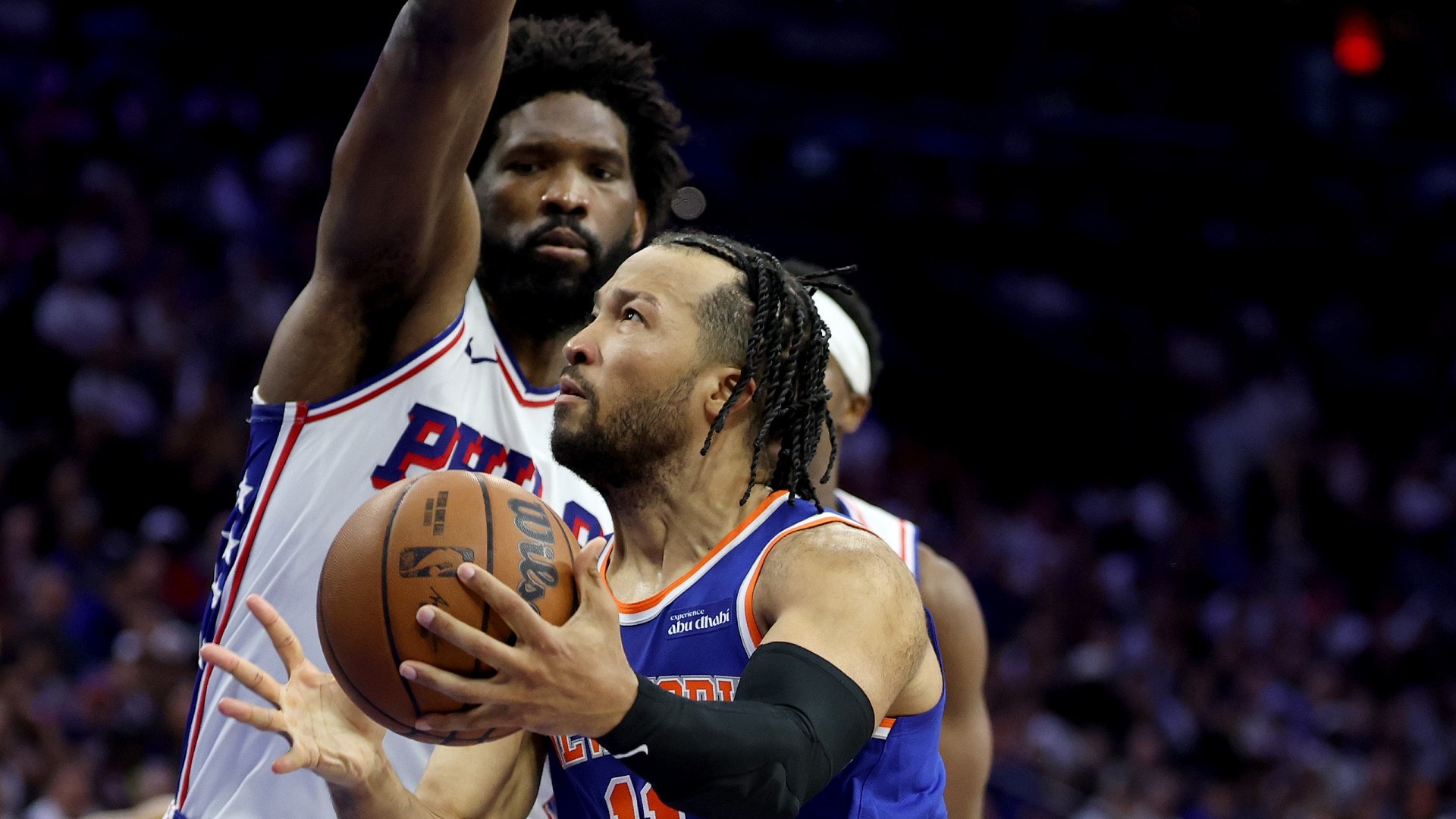
Jalen Brunson and the Knicks have feasted late in the shot clock against the 76ers.
No NBA team has ever lost a playoff series it led 3-0, and the New York Knicks certainly don’t look like they’ll be the first.
With six straight wins, they hold a 3-0 lead over the Philadelphia 76ers in the Eastern Conference semifinals, one win from their second straight trip to the conference finals and the franchise’s first best-of-seven sweep since 1999.
Here are three things to watch as the Sixers try to stay alive in Game 4 on Sunday (3:30 ET, ABC):
1. Sixers’ ball movement and quality shots
In Game 3, the Sixers had an expected effective field goal percentage of 55.6%, their highest mark in their 10 playoff games. But their actual effective field goal percentage was just 48.2%, their third lowest mark of the playoffs.
It’s a make-or-miss league, and this would probably be a 2-1 series if the Sixers just shot to their expected level on Friday. The game got away from them when Kelly Oubre Jr. and Paul George missed open and in-rhythm corner 3-point attempts on back-to-back possessions early in the fourth quarter. It was similar to the fourth quarter of Game 4, when they missed even more good shots.
But the Sixers can be encouraged that they got those good shots over the last 60 minutes of the series. And it’s noteworthy that the better shot quality in Game 3 came with increased ball movement. The Sixers made 302 passes in 19.8 minutes of possession (366 per 24 minutes) on Friday, up from 315 per 24 through the first two games.
The Knicks have been blitzing ball screens for Tyrese Maxey more often in the last two games, taking the ball out of his hands. But blitz coverage (two on the ball) can turn into great shots if the ball moves quickly:
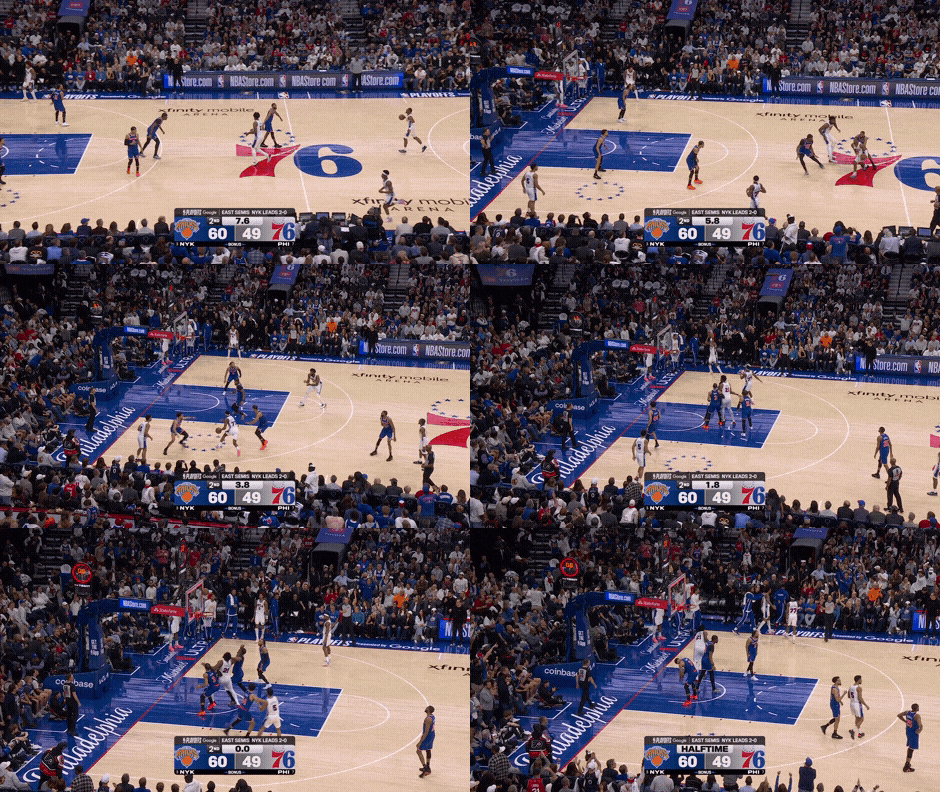
The overall results weren’t great on Friday, but the Sixers should continue to … trust the process. If the Knicks continue to blitz, more ball movement should lead to more good shots, which could keep their season going beyond Sunday.
2. Knicks’ late-clock success
The Knicks have shot better than expected in two of the three games in this series, only shooting slightly worse than expected in Game 2. Where they’ve really surpassed expectations is in the last seven seconds of the shot clock, where league-wide effective field goal percentage in the regular season was just 47.1%.
Knicks shooting in the last 7 seconds of the shot clock
| RS/Round | FGM | FGA | FG% | eFG% | Rank | %FGA | Rank |
|---|---|---|---|---|---|---|---|
| Regular season | 694 | 1,581 | 43.9% | 51.2% | 2 | 22% | 4 |
| First round | 53 | 147 | 36.1% | 40.8% | 12 | 29% | 1 |
| Conf. semis | 27 | 51 | 52.9% | 61.8% | 2 | 21% | 4 |
Through Friday, May 8.
It’s a small sample size, but small sample sizes are all you get in the playoffs. An effective field goal percentage of 61.8% in the last 7 seconds of the shot clock is incredible, and it doesn’t include the fouls that the Knicks have drawn late in the clock. There were seven of those in Game 3 on Friday, and they resulted in 11 Knicks points at the line.
The Sixers have lived late in the shot clock almost as much as the Knicks, but they have an effective field goal percentage of just 35.7% in the last 7 seconds. They lost Game 3 by 14 points and the score (including fouls) in the last seven seconds of the shot clock was Knicks 40, Sixers 8.
The math tells us that the Knicks should come back to earth a bit in regard to their late-clock success. But even if that happens, it might be too late for the Sixers.
3. Bench minutes
With Miles McBride replacing the injured OG Anunoby in Game 3, the Knicks’ starting lineup was outscored by 11 points in a little more than 12 minutes. But the Knicks dominated the minutes when reserves were on the floor.
Bench points (29-11 in Game 3) can be an overrated statistic. You don’t necessarily need your reserves to score a lot if they’re on the floor with one of your best offensive players, which is usually the case in the playoffs. They just need to push your point differential in the right direction.
And whether they’ve been scoring or not, the Knicks’ reserves have kept the scoreboard moving in the right direction all season. New York had the league’s third-ranked bench in the regular season and has had the second-ranked bench in the playoffs. Over their nine postseason games, they’ve outscored their opponents by 25.8 points per 100 possessions in Mikal Bridges’ 168 minutes off the floor and by 15.5 per 100 in Jalen Brunson’s 113 minutes off the floor.
The Sixers have had the 14th-ranked bench in the playoffs, and they’ve been outscored by an amazing 36.4 per 100 in VJ Edgecombe’s 103 minutes on the bench. So if their starters continue to play extended minutes on Sunday, you know why.
* * *
John Schuhmann has covered the NBA for more than 20 years. You can e-mail him here, find his archive here and follow him on Bluesky.